
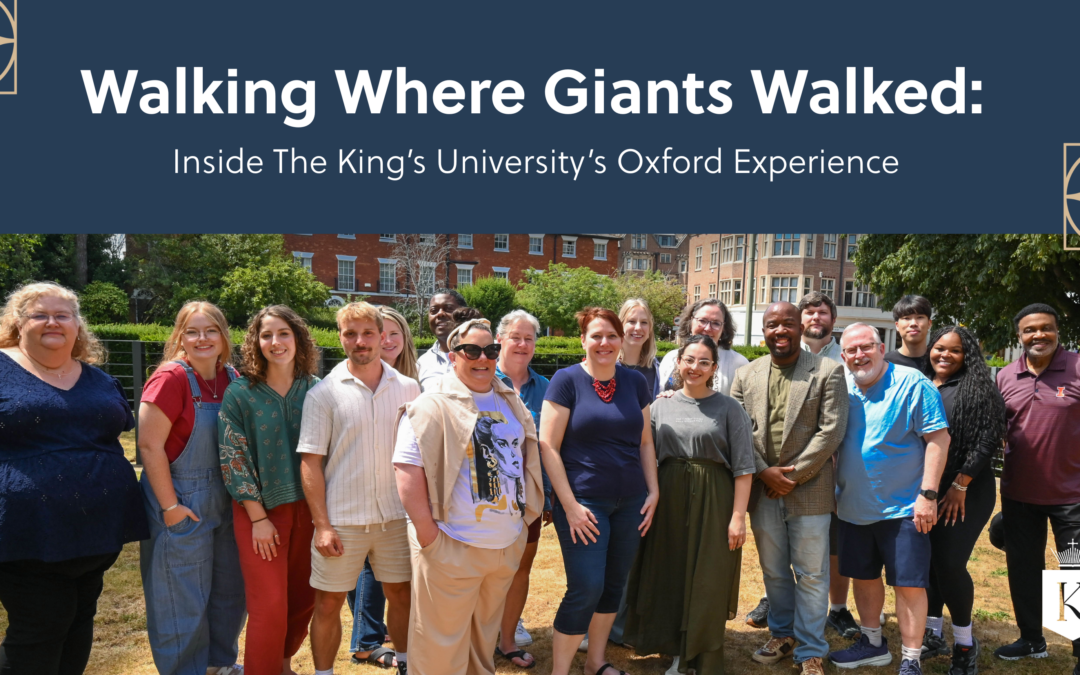
There is something awe inspiring about walking the cobbled streets of Oxford on an Oxford Christian study trip, knowing that this is where saints, reformers, and scholars once wrestled with truth. Saints like Edmund of Abingdon, a peacemaker appointed as Archbishop of Canterbury by Pope Gregory the IX. Or Thomas Cranmer, the architect of the English Reformation who was martyred for his faith by Queen Mary Tudor, for not renouncing his beliefs. Or John and Charles Wesley, the founders of methodism. They would host their Holy Club, at Christ Church, and later this group formed the denomination of the Methodists. John rode his horse 250,000 miles during his lifetime to preach the gospel and Charles penned 6,500 hymns in his. Together they sparked a revival that transformed the hearts of England —one through preaching and one through song — leaving a legacy of passion and faith that is still felt today. Then there are scholars like C.S. Lewis who led so many minds to fantastical worlds and deeper theology with books like The Chronicles of Narnia and Mere Christianity.
The profound ideas of these scholars have been carefully preserved within Oxford’s twenty-eight different libraries. Since its founding in 1096 – 350 years before the printing press – Oxford’s earliest books were handwritten, with only the professor possessing a copy. The first major library, Duke Humphrey’s Library, was established in 1435 when the Duke donated his collection of 300 books to Oxford. Though only three of those original volumes survived the religious upheavals between Catholics and Protestants, his donation laid the foundation for what would eventually become the Bodleian Library. Today, the Bodleian alone houses over five million books, continuing Oxford’s legacy of preserving and expanding knowledge.
The richness of the libraries alone is an appealing reason for any student to yearn for immersion in the centuries of knowledge, wisdom, and discovery waiting to be uncovered. The King’s Oxford Experience offers just that. We offer our students a chance to walk with the giants of the faith and traverse the city which holds such rich history. The Oxford Experience is more than just a Christian study trip; it is academics and spiritual formation at its finest. This is where learning becomes worship. Each morning, before breakfast, we gather for student led worship and devotion. Our students are given the opportunity to lead their peers in a time of spirit formation. These moments serve as a living expression of The King’s commitment to developing students in both Christian leadership and education. After breakfast, our group assembles in the intimate seminar room at St. Anne’s College, one of the forty-three colleges at Oxford University, for a lecture from one of The King’s esteemed faculty members. We break for lunch and join students from over 110 universities around the world in St. Anne’s elegant, Harry Potter-esque dining room. After lunch we gather for another series of lectures, then for dinner we encourage our students to mingle with other students in the numerous restaurants surrounding the university. This gives the students opportunity to form community with their fellow classmates and faculty members. There’s something about the commensality of students gathered at the table, which echoes ancient Christian traditions of shared meals and spiritual fellowship. These meals foster a sense of community and offer students — especially those who are typically online learners— a valuable opportunity to build friendships with their peers.
The Oxford Experience isn’t just a Christian study trip, and it doesn’t solely focus on academics; it also offers students an opportunity to immerse themselves in culture and tradition. During the two-week emersion, we visit historical landmarks like Westminster Abbey and St. Paul’s Cathedral. The Abbey was founded in 960 by Benedictine Monks. King Henry the VIII modernized its current gothic architecture in 1245, and today it houses the burial sites of England’s famous monarchs and poets. It also hosts venues like the king’s coronation and weddings for royalty. The first St. Paul’s Cathedral was built in 604 but was destroyed in the great fire of London in 1666. Sir Christopher Wren — who built the Sheldonian Theatre in Oxford — was also commissioned to build the new St. Paul’s Cathedral. The cathedral famously withstood the London Blitz during World War II and became a powerful symbol of British resilience. This Anglican masterpiece is one of the most beautiful sites we visit during our time in England.
Yet even amidst such grandeur, there is something moving about the quieter beauty of Christ Church’s chapel, where the ancient tradition of Evensong continues to draw hearts into worship through word, silence, and sacred song. We will have the opportunity to worship together in this sacred tradition and experience something many of our students have never participated. Just outside the walls of Christ Church the lively streets of Oxford await us. This contrast between the contemplative and the communal is part of what makes this Christian study aboard journey so rich.
The Oxford Experience gives students a chance to walk the same streets once trodden by giants of the faith. It allows students to grow academically and spiritually, in community with others, while encountering sacred tradition in a living context. Walking the cobblestones of Oxford is not just an opportunity to enhance your knowledge — it invites your mind and spirit to engage the world beyond The King’s University. While The King’s prepares you with biblically sound education and practical ministry, the Oxford Experience helps to spiritually form you and expand your understanding of our global Christian heritage, so that you can impact the world in meaningful ways — just like the giants who came before you.
For 2026, students (apply at tku.edu/apply) can choose the schedule that best fits their goals and summer plans. Each week offers three credit hours, and those who participate in both weeks can earn a total of six.
Week One: July 12–18 (3 credit hours)
Taught by Dr. Kenneth Ulmer (former King’s president)
• BIBM 3351: The Gospel and Cultural Transformation
• BIBM 6351: Faith and Culture: Engaging Justice in Today’s World
This week explores how the message of Jesus shapes communities, challenges injustice, and speaks into today’s cultural conversations. Students will examine the intersection of faith, justice, and societal change with one of the leading voices in this field.
Week Two: July 19–25 (3 credit hours)
Taught by Dr. Frank Markow, Program Director for Organizational Leadership at The King’s Seminary
• BIBM 3352: The Leadership Revolution: Lessons from the 20th Century
• BIBM 6352: The Leadership Revolution: Theory and Practice from the 20th Century
This week offers a focused study on leadership frameworks that emerged from pivotal moments in the 20th century. Students will dig into the ideas, movements, and models that continue to influence how leaders think and lead today.
Full Session: July 12–25 (6 credit hours)
Students who attend both weeks will experience a broadened academic journey—one centered on cultural engagement and one on leadership development—earning six credits in just two weeks.
For more information, please email oxford@tku.edu or you can also attend an online Zoom informational meeting on January 22, 2026 at 7 pm CST by registering here.
